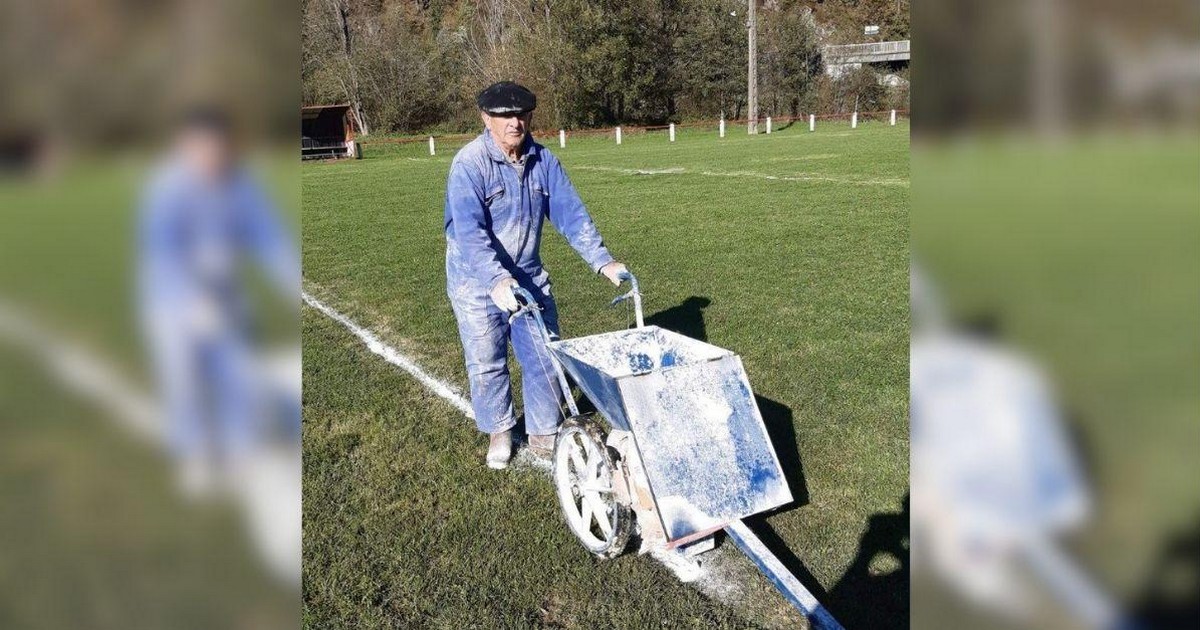
He is 80, and he still marks the pitch himself
Long before the cameras, the punditry and the polish of the professional game, there is the white line.
At a small amateur club in south-west France, Henri Lembeye is still the man who puts it there. He is 80, and he still marks the first-team pitch himself, pulling on the same blue overalls and getting on with the sort of work most people only notice when it has not been done properly.
That image tells you almost everything. Not because it is quaint, and not because it belongs to another era, but because rugby still depends on people like this far more than the sport likes to admit. Every rugby country knows the type. The person who opens up, sets up, clears away, checks in on everyone and keeps the whole place moving without ever asking for recognition.
Henri is one of those people. In truth, he has been for most of his life.
More than a supporter: the many lives Henri has lived inside one club
Henri has been part of his club since he was 17. In that time, he has done far more than stand on the touchline.
He played until he was 42. He also served as a coach, a carer, a president and, as ever, a volunteer willing to help wherever he was needed. He was there when the club built its stands and installed its lighting. He has seen the place change, grow, struggle and carry on. At this level of the game, that matters. Continuity does not come from branding or strategy documents. It lives in people.
Rugby tends to celebrate service when it comes with caps, medals or a long professional career. Community rugby has its own version of that. It is measured in winters, training nights, muddy boots at the door and jobs done simply because someone has to do them. Henri’s life at the club fits that mould exactly.
He is not just an old supporter with a nice story attached to him. He is part of the club’s memory, its rhythm and its identity.
The kind of man every rugby country recognises
That is what gives this story its reach beyond one village in France.
You could tell it in England, Wales, Ireland, South Africa, New Zealand or Australia and most club players would recognise it straight away. Every rugby community has its Henri. The man or woman who never seems to miss a session. The person who knows where everything is, remembers everyone and has quietly done half a dozen different jobs over 40 years.
The professional game runs on money, staffing, broadcast schedules and performance departments. The amateur game still runs on habit, loyalty and unpaid labour. On someone remembering to open the gates. On someone else putting the kettle on. On someone like Henri making sure the pitch is ready.
That is why stories like this resonate. They are not really about nostalgia. They are about the hidden workforce beneath the sport — the people without whom the match does not happen.
At clubs like this, memory is part of the team sheet
Henri is not some distant figure from the club’s past. He is still there, still involved, still part of the weekly life of the place.
According to those around him, he never misses training. He comes to greet the players. He checks on the injured. He remains part of the rhythm of the club, and that gives him a role far beyond ceremony. He is not there to be wheeled out for applause once a year before kick-off. He is part of the atmosphere players walk into every week.
That matters more than it might first appear. Small clubs are held together by memory as much as manpower. When current players feel connected to the people who built the place before them, the shirt carries a little more weight. Tough matches feel a little less ordinary. Lean seasons become easier to ride out.
People at the club speak about Henri in exactly those terms. Not as a mascot, but as a source of perspective. Someone whose presence reminds players that they are part of something older and bigger than the weekend’s result.
The family-meal detail that explains everything
The most revealing detail in the whole story is also the simplest.
Henri once left in the middle of a family meal to get to a match. By all accounts, it was not an isolated incident. There were times when rugby came first, even if that meant cutting lunch short or slipping away from a family gathering.
It is a funny image at first. A little stubborn, a little old-school, very rugby. But it also captures the depth of his attachment to the club better than any grand tribute could. This is not just interest. It is not even loyalty in the loose, easy way the word is often used in sport. It is commitment, built through repetition over decades.
The same goes for the one match he is said to have missed only because he was away travelling in 2018, when the club reached the final of a lower-tier national amateur competition. Even that absence stands out because it seems to have been so unusual.
His daughter adds another detail that sharpens the portrait. Away from rugby, Henri worked as a mason, a man who liked doing things properly and took pride in a job well done. The link is easy to see: the carefully marked pitch, the tidy routine, the sense that if something is worth doing, it is worth doing right.
What small clubs lose when one person stops showing up
That is the other truth running through this story.
At the top end of the game, one absent executive barely changes the feel of a week. In community rugby, one absent volunteer can be felt everywhere. Not always dramatically, but practically. The pitch is not marked. The injured player is not checked on. The quiet word after a loss never comes. A thread loosens.
Henri’s value lies not only in what he does, but in what he represents. He brings reassurance. He brings consistency. He provides a kind of emotional maintenance no spreadsheet will ever capture.
That is why clubs talk about people like him with such feeling. Not because they are trying to be sentimental, but because they understand how fragile small sporting institutions can be. They survive through accumulation: enough people doing enough things, often for years, sometimes for decades. Remove too many of those people and the club does not just weaken. It starts to lose its sense of itself.
Henri, by contrast, has spent a lifetime making sure that does not happen.
Professional rugby gets the cameras. Community rugby gets built by people like this
There is no need to overcomplicate the lesson here.
Rugby loves to sell its biggest names, biggest collisions and biggest occasions. Fair enough. That is part of the sport too. But none of it exists without the base beneath it, and that base is still built by people whose names will never trend and whose work is rarely noticed beyond their own ground.
Henri Lembeye is one man at one amateur French club. But he also stands for something much bigger than that. He stands for the countless club volunteers every rugby nation recognises immediately: the people who arrive early, stay late, ask for nothing and quietly become indispensable.
At 80, he is still marking the pitch. That is the headline. The deeper truth is that rugby, for all its money and noise at the top, is still held together by whitewash, routine, memory and service.
In clubs all over the world, the game is still alive because somebody like Henri turned up again.

-thumb.jpg)

-thumb.jpg)












Aucun commentaire pour le moment...